Dominions
A dominion is a system you rule but do not run. It develops by itself and pays you a share of what it makes.
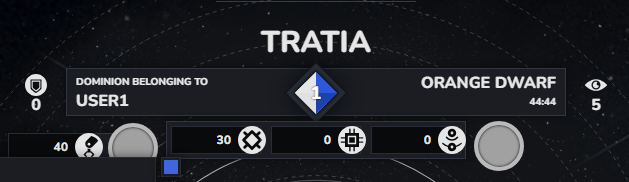
What a dominion gives you
- A share of its credit, technology and ideology. See Dominion Tax Rate.
- It builds by itself. See Self-development.
- It counts toward your faction's score, like your systems. See Population class.
Your active lexes and your faction's traditions apply to a dominion the same way they apply to your systems.
What you cannot do there
You cannot order buildings or ships in a dominion. Unlike your own systems, a dominion gets no defense from its population.
Getting a dominion
A Siderian in the system can use Control to make it your dominion.
- It works on an autonomous system.
- It also works on another player's dominion, even a faction-mate's.
- It never works on a system a player runs.
- You need a free dominion slot. See System and dominion limits.
- The system must be in a sector your faction holds, or next to one. See Star systems.
- The higher the system's stability, the more likely a Control fails.
No Navarch can stop a Control, whatever its stance. See stances.
You can also turn one of your own systems into a dominion with Liberate, and a dominion back into your own system with Administer. See Administrative Operations.
Losing a dominion
- You use Abandon on it. It becomes autonomous and no one owns it. See Administrative Operations.
- Another player's Siderian uses Control on it. It becomes their dominion.
- A Navarch's conquest takes it. It becomes the conqueror's system. See Star systems.
Under attack
A Navarch can bombard or pillage your dominion. A successful pillage takes its loot from your own credit, technology and ideology, not from the dominion. The loot is based on the dominion's full output, even though you only receive a share of it. See siege.
If a dominion's output is negative, your share of it is negative too, so it lowers your income. See Dominion Tax Rate.
Numbers shown for Flash games. This page is the same at every speed.