The late game
Learn how specialists reach their peak, why fleets can cost more than one player earns, and how a team carries that load.
In a Legacy match the late game starts around the twelfth real day.
Finish your focus
The last patents unlock the buildings that top off a specialist.
- The Monolith pays ideology for the population of the whole system.
- The Metamaterials Factory pays production and technology from one barren planet.
- The Business Arch and the Reflect District pay credits for mobility. Both lower stability.
Levels matter as much as new buildings. The last level of Urbanization lets the Megapolis reach level 5. The other buildings on that planet can then follow. Barren planets and moons have patents of their own for that.
Your most valuable systems are targets for raids and destruction. Keep them in your faction's backline, or defend them. Defense buildings work against fleets, high Intelligence against Erased and high stability against Siderians.
Fleets
Warships are built in a system with a shipyard. Each warship class needs its own. The S-01 Assembly Line builds fighters and the Assembly Superstructure builds capital ships.
- One of your Navarchs must wait in that system, with no orders, to receive the ships. It cannot move until they are finished.
- A ship costs credits when ordered, and most cost technology too. The system's production then builds it.
- No ship can be ordered in a system under siege.
- A fleet holds 18 squadrons.
Most teams build their warships in few systems with very high production. A Navarch governor with the Shipowner specialization helps there.
Fleets can cost more than you earn
Every finished ship costs credits all the time, for as long as it exists. A docked fleet costs the same as a moving one. Agents on the map and governors also draw a wage that grows with their level.
Big ships cost a lot. Two or three full fleets can cost more than all the credits one player makes. This is intended. Fleets are a team effort.
If your credits reach zero while your income is negative, you are bankrupt. The top bar shows "Your empire is bankrupt".
- Your agents go on strike and refuse new orders.
- Your Navarchs switch to the Deserter stance.
- You cannot order buildings or ships, or hire agents.
Nothing is destroyed. But your credits keep falling below zero, so the debt grows. It ends when your credits are above zero again, or when your income is no longer negative. Set your stances back afterward.
So fleet holders ask the team's bankers for credits, often and in large amounts. You can still Claim a credit donation while bankrupt. Claiming costs a tax, but it comes out of the donated credits. You need none of your own.
Who holds the fleets
A team has to balance three things.
- Activity. A fleet does the most in the hands of a player who is there to move it.
- Credits. A banker can pay for a fleet alone, but may not be the most active player.
- Navarch slots. Each fleet needs a Navarch. The Navarch Limit comes from active lexes. A Navarch that governs a system uses a slot too. See Agent limits.
Fleets can change hands. You can donate a Navarch from the map with its fleet, while it has no orders. The taker needs a free Navarch slot and pays a tax in credits that grows with the fleet. From then on the taker pays the upkeep.
Where fleets sit
A fleet does not add to a system's defense. It defends by fighting enemy fleets, and only in the system where it sits.
- The Navarch's stance decides when it fights. A new fleet is a Defender. It fights when an enemy starts to Pillage, Bombard or Conquer there. Two other stances also stop enemies as they arrive. See stances.
- Teammates' fleets in the same system can join the battle, if their stance allows it.
- No stance stops a Siderian or an Erased. Those roll against the system's stability and Intelligence, or against the target agent's own Protection and Determination.
- A fleet without orders repairs itself, if it has ships that repair or its Navarch has Leadership points.
- Enemy S.L.S.D. only shows fleets that move. An enemy agent in the system still sees a parked fleet.
Decide with your team which systems need a fleet most.
Choosing targets
A fleet can Pillage, Bombard or Conquer a system. See siege.
The systems that hurt most to lose are a team's shipyard systems and its best credit, technology and ideology systems. That is as true for your rivals as for you.
Look before you strike. The more your faction sees of a system, the better you can judge it.
Agents in the late game
This part of the manual is still short. More pages are coming.
- A Siderian's Destabilize lowers a system's stability. At zero stability or below, a system loses part of everything it makes.
- A Siderian's Control takes dominions and autonomous systems. It needs a free slot under your Dominion Limit. Low stability makes it easier.
- An Erased's Infiltrate the network shows your faction more of a system. In a system of another faction it also counts toward Path of Shadows.
- An Erased's Sabotage hits a fleet where it sits.
These work best in groups and with timing. Ask your teammates for tips.
The example system
This is Lyceum at the end of the match.
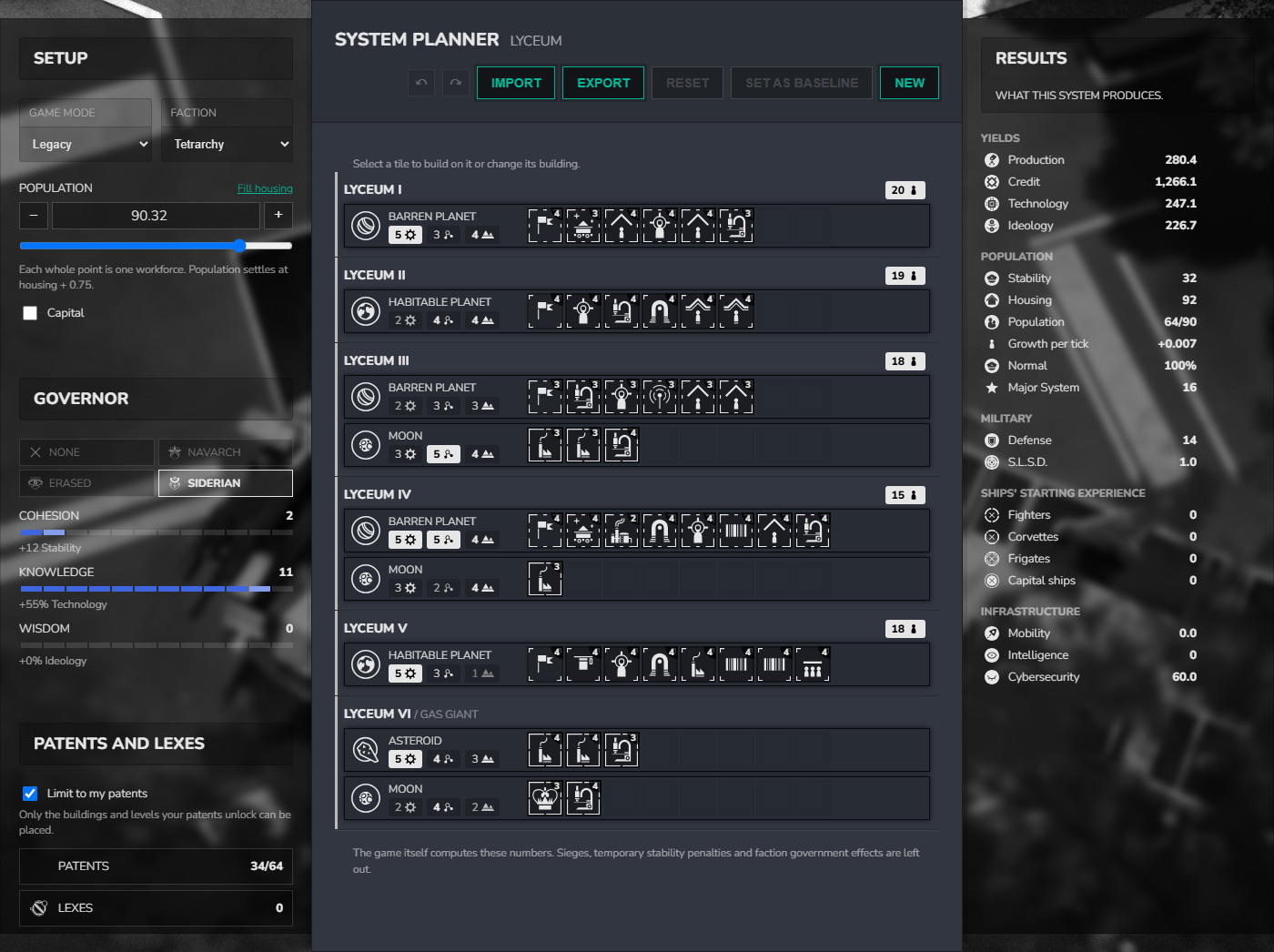
- A Metamaterials Factory stands on the fourth planet, the one with the two potentials of 5.
- The Accelerator is at level 4.
- The governor has 11 points in Knowledge. That alone adds more than half to the system's technology.
- Technology has nearly doubled again since day twelve.
- Only 64 of 90 workforce is in use.
Lyceum ended among the best technology systems of its match. It is good, not perfect.
Can you do better? Open Lyceum at the end of the match in the system planner and try. Raise the buildings that are still at level 3. Look at the unused workforce, the stability and the defense.
Back to Strategy basics.
Numbers shown for Legacy games. This page is the same at every speed.